
Harnessing AI for consultancy growth
In December 2022, ChatGPT reached 1 million users, just five days after it was launched. Since then, consulting businesses have been trying to find the answer to how it can make them more productive, deliver at a lower cost, and fuel growth.
But AI is not a strategy, it’s a tool.
And ‘easy to use’ doesn’t mean ‘safe to use’. There are reputational risks, ethical blind spots, bias and confident nonsense (hallucination). If you’re not deliberate, AI will increase your output while reducing your trustworthiness.
We were recently joined by Umbar Shakir, former partner at Gartner Consulting and Chief AI Officer at Havas, on one of our member online workshops to share her insights into how consultancies are successfully turning AI into a commercial advantage.
This insight is structured around five themes from Umbar’s approach. At the end, there’s a separate five-step 30-day starter plan you can apply straight away.
1. Protect the ‘craft’, offload the ‘graft’
According to Umbar, craft is judgement, expertise, client relationships, the ability to navigate ambiguity and earning trust.
The real prize is less graft, more human, more creativity.
Graft is the work you have to do but doesn’t add the true value. It’s the first drafts, the summaries, the formatting, the meeting prep, the analysis clean-up, admin and internal comms that must exist but rarely create differentiation.
Generative AI is at its best when it removes graft so your team can spend more time on craft. The real prize, says Umbar, is “less graft, more human, more creativity.”
She says that once you see it this way, you stop asking ‘where can we use AI?’ and start asking a better question:
“Where’s the real value in what I do?”
Umbar advocates working backwards from there to think: “where can AI help with the parts that don’t require our critical thinking, to free up more time and space for us to work on the things that do.”
2. Start with outcomes, not tools
Many AI conversations ask: Which model? Which app? Which plug-in?
That’s the wrong question to be asking. Consultancy leaders need to start with outcomes, then work backwards to use cases.
Umbar notes that across consultancies, AI tends to create advantage in a handful of repeatable ways, “from turbocharging insights and analytics through to accelerating and improving delivery performance and time to resolve issues; speeding up regulatory compliance; using AI to engage better with customers and to develop and design better customer experiences.”
Here are a handful of repeatable ways Umbar sees AI creating an advantage.
- Faster commercial momentum: you turn up to calls better prepared, you follow up faster and your propositions get sharper.
- Higher delivery leverage: less time lost to the ‘paperwork’ around the work, quicker turnarounds, fewer rounds of rework. You keep quality up while freeing capacity.
- Better insight per hour: instead of spending ages pulling threads together, you can synthesise sooner, test more angles and get to a clear view faster.
- Stronger client experience: clients get clearer updates, quicker answers and more proactive guidance, and your team is not burning itself out to provide it.
3. Apply AI to the sales cycle first
If you want early ROI from AI, Umbar suggests focusing on business development and account growth first.
Relationship selling is a loop: know your market, plan sales and client engagements, network and outreach, deliver and track, then listen and adapt. Umbar is clear that generative AI can support each stage by making the work around relationship building tighter and more consistent, without replacing the relationship itself.
In practice, that might look like:
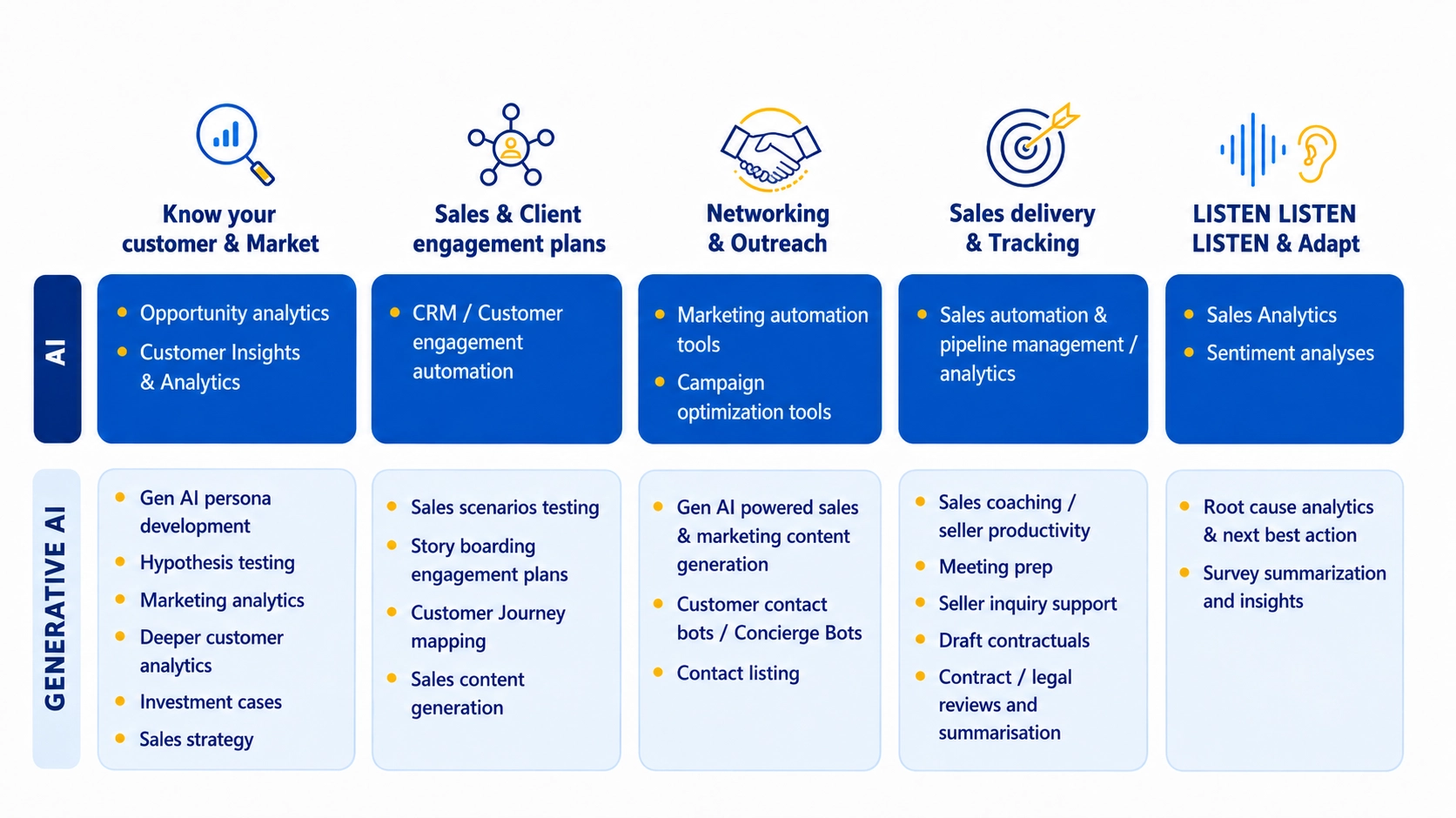
Umbar’s point is not to produce more content. Her point is to make your team more prepared, more responsive and more commercially intentional.
Use three ‘job types’ to build your AI catalogue
To avoid random experimentation, Umbar’s recommendation is to group use cases into three job types.
- Creation: strategies, plans, comms, outlines, drafts.
- Summarisation: long documents, websites, meeting transcripts, research.
- Interpretation: comparisons, analytics, sentiment, decision support.
She suggests picking one high-frequency task from each category and running a small pilot.
Part two of this three-part AI series focuses on using AI for sales. Read it here:
4. Make prompting a capability, not a party trick
We all know that good prompting is not about cleverness, it is about clarity.
When speaking to our members, Umbar explained that a simple structure is enough for most teams: act as a role, create a task, show as a format. Her rationale is that the role provides perspective, the task provides direction and the format saves time and reduces ambiguity.
As Umbar says, “If you want your team to get value quickly, start simple. Give them a shared prompt library with examples that match your services, your tone and your quality bar. Then make it normal to iterate, because the first output is rarely the best output!”
If you would like to take your prompting to the next stage, here is a useful cheat sheet:
5. Put guardrails in place, then scale
AI is adding real leverage for consultancies, but that only works if you treat it like any other capability that influences client trust. Set the boundaries first, then expand usage inside those boundaries.
These boundaries usually come down to:
- confidentiality and trust: what data is allowed in which tools, and what never leaves your environment.
- accountability for quality: who signs off outputs, and what human review actually means in practice.
Umbar sets out a sensible starting position:
- use AI freely for low-risk internal graft (summaries, outlines, internal drafts)
- use AI cautiously for client-facing drafts, with named human accountability and mandatory review
- avoid using public tools with confidential client information unless you have an approved, secure set-up and a clear policy.
Five actions to take in the next 30 days
At the end of her workshop, Umbar provided a practical ‘what next?’ for our members. A condensed action plan that reflects her recommendations: protect the ‘craft’, offload the ‘graft’ and be deliberate about prompting and boundaries.
- Map where your team is spending time on graft across sales, delivery and ops
- Choose three use cases that are frequent, low-risk and measurable
- Create a shared prompt library using role, task and format, aligned to your core offers
- Set two boundaries (for example, no confidential inputs into public tools, no unreviewed AI output to clients).
- Track time saved and quality improvements, then double down on what actually moves the needle.
The truth is, clients already expect you to be using AI, so they’re also expecting quicker turnaround and more polish. You may as well plan for that now.
The consultancies that win will be the ones that use AI to free up more time for judgement, expertise and client relationships. This is where you add the real value that your clients can’t buy anywhere else.
Article | OperationsStrategy and leadership

Written by
James Hurman
Digital Marketing Manager
The Consultancy Growth Network